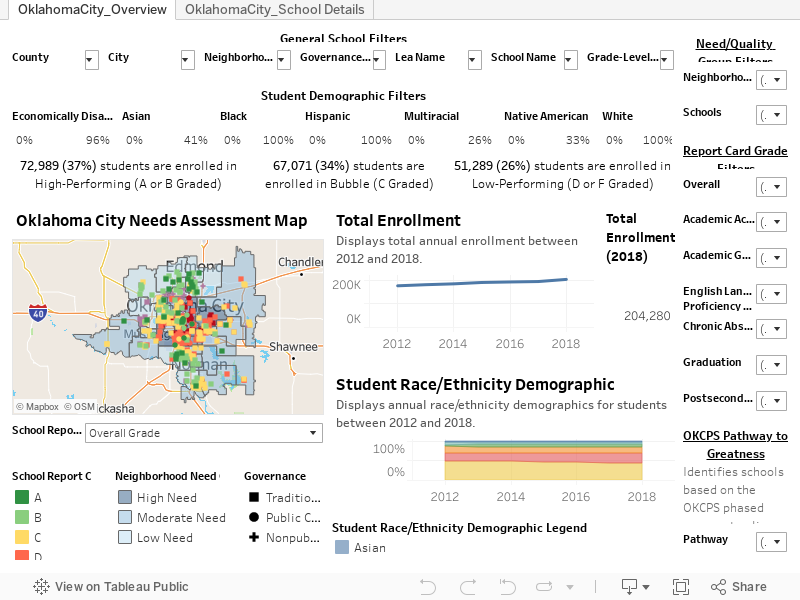
 Raising Quality, Promoting Equity: An Analysis of Location, Performance, and Challenges Facing Oklahoma City Public Schools is a needs assessment for K-12 public education in the Oklahoma City metro area.
The primary objective of the needs assessment is analyzing students’ access to high-performing schools in their neighborhoods. More specifically, the assessment seeks to equip local school leaders, public officials, philanthropy, and other community stakeholders with the information and analysis tools needed to make data-informed decisions around school improvement. While the needs assessment focuses primarily on school quality, it also aims to provide important insights around neighborhood characteristics that are known to influence school quality and educational outcomes.
The target geography for the needs assessment includes the physical boundaries of the 23 largest school districts in the Oklahoma City metro area. The assessment primarily focuses on the traditional public and public charter schools located within this geographic footprint, although some context is provided on the region’s non-public schools and virtual charter school students. The needs assessment uses the Oklahoma State Department of Education’s School Report Card to identify high-performing schools as well as further contextualize other aspects of school quality.
DOWNLOAD THE PDF | Recommendations | Online Tool
Press questions may be directed to Katie Coleman at 312 521 7381.
Please visit our online library for earlier IFF studies on the education sector.
Recommendations
1. Tailor and scaffold school improvement strategies to fit specific neighborhood’s profiles.
Neighborhoods that were placed into the high and moderate need groups shared similar high-level school quality makeups but possessed very different characteristics which may lend toward different improvement strategies.
- High Need Neighborhoods – Eastern Oklahoma City: These neighborhoods are characterized by predominately Black and economically disadvantaged student populations. A key characteristic of these neighborhoods was declining student enrollment, though. Although fewer students may be enrolled in the neighborhoods’ schools, they still demonstrate significant need for supports and may benefit from both school interventions and comprehensive community development efforts.
- High Need Neighborhoods – Southwestern Oklahoma City: These neighborhoods are characterized by predominately Hispanic and economically disadvantaged student populations. A key characteristic of these neighborhoods was significant student enrollment growth. As student enrollment continues to grow, improvement strategies should focus on making sure supports are in place to serve larger student bodies and specific needs that the Hispanic community may need, such as English language instruction. These types of supports may come from school interventions as well as external community supports.
- Moderate Need Neighborhoods: The profiles of moderate need neighborhoods throughout the region varied widely. These neighborhoods are located in the rural portions of the needs assessment area to the west and east, along the city’s northwestern corridor and in the southeast portion of Norman. The neighborhoods are characterized by stable measures of school quality but particularly as student enrollment and demographics shift throughout the region, vigilant monitoring should be conducted and targeted actions taken to maintain current quality levels as well as make improvements. This may come in the form of small-scale school interventions as well as partnerships with non-neighboring districts and schools that have demonstrated success with similar student populations.
- Low Need Neighborhoods: Although schools within low need neighborhoods demonstrate the highest measures of school quality, they can potentially benefit from sharing successful practices that they have implemented as well as partnering with stakeholders from moderate and low need neighborhoods to identify ways in which they can support student populations that they have not traditionally served in large numbers. This type of knowledge sharing will be important as enrollment and demographic trends continue to shift throughout the region.
2. Further investigate the school accountability report cards.
In its first year of implementation, the Oklahoma Department of Education’s school report cards provide extremely important insights around school quality. Stakeholders may benefit form collaborating with the State Department of Education and other experts about how to better understand the nuances of the accountability system as they make efforts to spur improvement. Emphasis should be placed on unpackaging the details of the chronic absenteeism and postsecondary opportunities and the relationships ad their relationships with the academic achievement, academic growth and graduation indicators.
3. Conduct deeper analysis of teacher staffing trends.
In recent years, robust discussions around teacher staffing levels, retention, certification and their relationship with school quality have taken place. The findings of the needs assessment substantiate concerns that stakeholders have raised about the cultivation and preservation of teaching staff in all neighborhoods, but particularly those that demonstrate the highest need for school quality improvement. Significant attention should be paid to investigating what steps can be taken to improve teacher recruitment, ongoing professional supports and retention, particularly in high need neighborhoods. Supports for teachers with emergency certifications also warrants further investigation. Between academic years 2015 and 2018, the number of teachers teaching in the needs assessment area’s schools increased from 190 to 618.
4. Prioritize comprehensive community development efforts.
The demographic data analyzed by the needs assessment shows strong relationships between median household income, adult educational attainment, housing and K-12 school quality. The neighborhoods that demonstrated the highest need for school quality improvement were also characterized by lower median household income, smaller densities of adults with Bachelor’s degrees and older housing stock. As stakeholders make efforts to improve K-12 school quality, it will be important to identify opportunities to address some of these other indicators which are not all tied directly to K-12 school activities but may significantly influence students’ educational experiences and outcomes. Some of these high-level community development activities may include investments into affordable housing, adult educational programs and other workforce initiatives.
Online Tool