Four Ways to Make Early Learning Spaces More Accessible for All Children October 29, 2025

The written content below is also available in an audio format:

IFF's Dedication to Universal Access for ECE

Inclusive design is at the heart of IFF’s mission to increase access to high-quality child care for all families across the Midwest. Through renovations and repairs, we have helped numerous ECE providers incorporate elements that create more welcoming, accessible, and inspirational spaces in existing facilities. IFF has also developed several new ECE facilities that demonstrate how universal access can be integrated into the design of early learning spaces to maximize positive outcomes for all children. One of these facilities, the Marygrove Early Education Center in Detroit, incorporates all the principles in this article. Read about it and take a photo tour here or take a virtual tour here.

Safe and inspiring learning environments lay the foundation for positive early childhood experiences, helping to facilitate learning, development, and well-being among infants and toddlers. But a truly impactful early learning space goes beyond aesthetics and general comfort to consider the needs of all children who will use the space, including the more than three million in the United States who have a disability. By prioritizing inclusive design for children with physical or developmental disabilities, or universal accessibility, early childhood education (ECE) providers can ensure that every child who comes through their doors has the opportunity to grow, learn, and feel safe – while also creating more functional spaces that benefit families, caregivers, and staff.

IFF works hand-in-hand with ECE providers to facilitate building upgrades rooted in inclusive design and universal access, which considers layout, air quality, temperature, ventilation, noise, lighting, furnishings, and outdoor play areas. These areas are priorities because of their outsized contribution to accessible, high-quality learning environments proven to positively impact young children’s development.

To help ECE providers increase the accessibility of their facilities, we’ve compiled an overview of best practices to create inclusive early learning spaces that can be incorporated into the planning process for new facilities or implemented to upgrade existing facilities. At the bottom of the page, we’ve also included project ideas that ECE providers can pursue at several price points.

Space Use and Accessibility

The design and layout of ECE spaces are crucial to creating safe, welcoming, and engaging spaces for all children, and inclusive design allows children with disabilities to fully engage in the early learning experience. When considering how to design accessible, welcoming early learning spaces, there are several rules of thumb to keep in mind to encourage inclusion:

  • Eliminate physical impediments or barriers
  • Eliminate blind spots
  • Maximize efficiency and safety
  • Establish clearly defined areas based on the activities that will take place in them
  • Maintain flexibility for a variety of uses and activities
  • Promote independence for every child

A more open floor plan, for example, allows space for mobility devices and makes it easier to organize the room into distinct activity areas that help children focus and more deeply engage in their development. Toward that end, it’s important to have ample storage space for materials that aren’t needed for the activities at hand. This aids in reducing visual clutter, which provides meaningful benefits covered in the “color and visual clutter” section below. Modular furniture can also increase flexibility, making it easier to convert spaces in the facility for different uses. Wider doorways can meaningfully increase the accessibility of an ECE facility, as can ramps and railings, making it easier for those who rely on mobility devices and those using strollers to access and/or navigate the building.

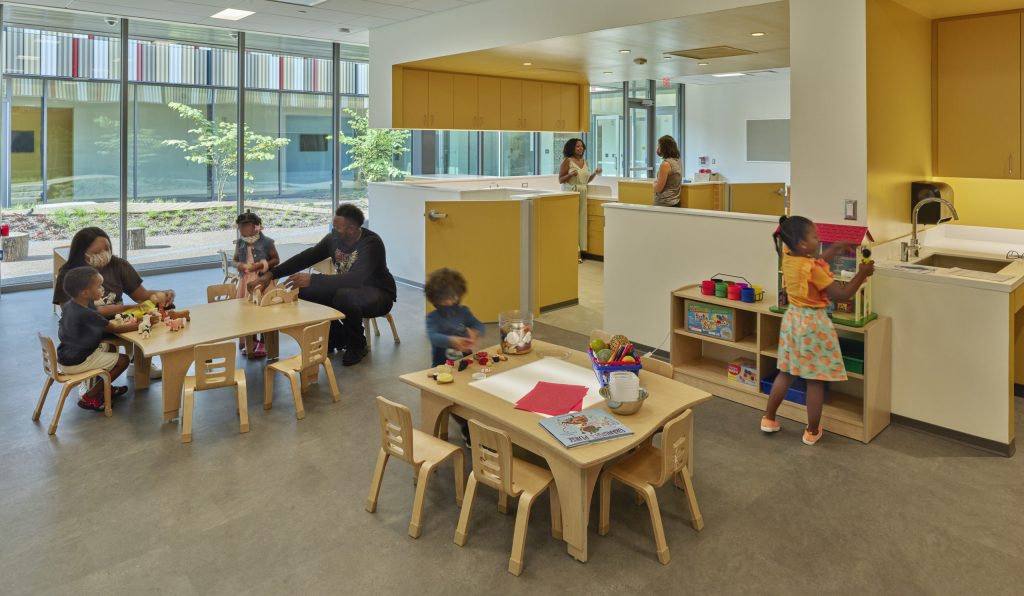
An early childhood education space with children engaged in activities and large windows providing natural light.

Bathrooms in ECE facilities also provide a compelling example of the importance of inclusive design. In addition to barrier-free entry, it’s important to have child-sized or low toilets; roll-under sinks that meet minimum standards of height, clearance, and depth to accommodate wheelchair users; grab bars; motion activated faucets; and no high-powered hand dryers. Air dryers can be disturbing or physically painful to children with sensory issues, can cause skin irritation, and, if not thoughtfully placed, may create additional physical accessibility obstacles.

Child using a step stool at a sink in a child care center, with play area in the background.

The importance of accessibility also extends to outdoor spaces. Rubberized accessible surfaces instead of wood chips are easier for children with limited mobility to navigate, while also being a cleaner option for all. And while playground equipment specifically designed for all kids to be able to use the same way is ideal, there are less expensive options for providers that can still result in meaningful improvements. Everyday items like raised planter beds can be used to create a sensory garden or water feature, while sensory walls can be created with little more than peg boards and PVC pipes.

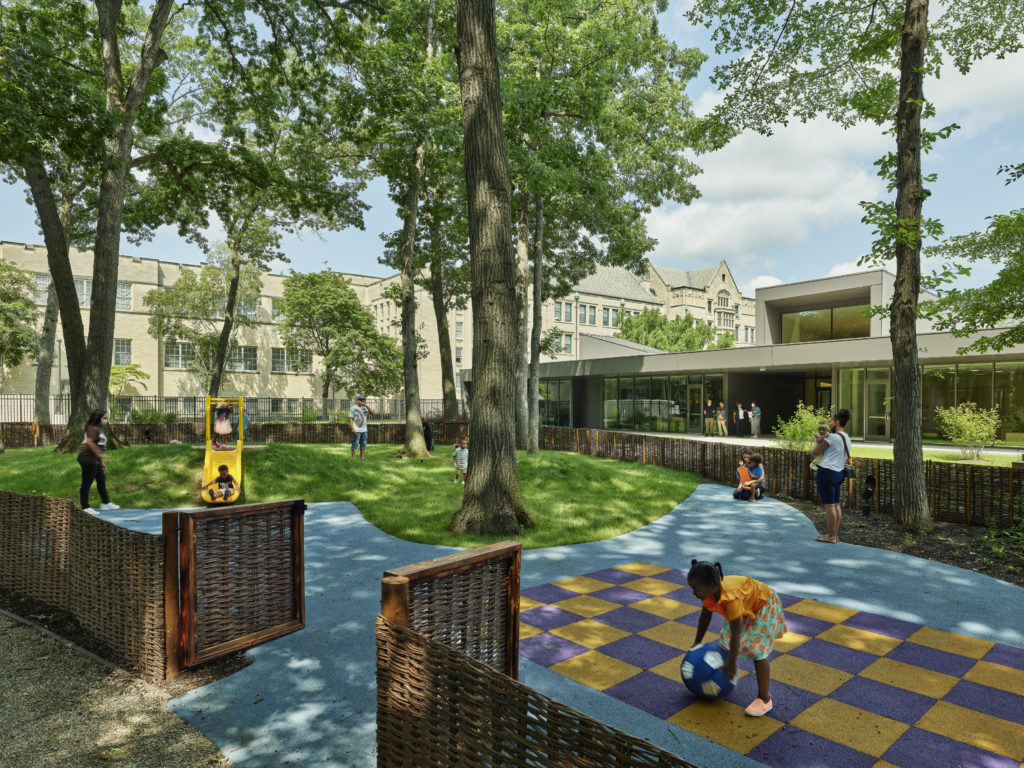
A playground with trees, a grassy area, blue pathways, and a checkered play area. A modern building is visible in the background.

Children and an adult engage in a sensory play activity at a white table in a classroom.

Lighting

Adequate and appropriate lighting, both natural and artificial, is essential for creating a comfortable, engaging, and secure environment that supports children’s well-being and learning. It creates comfort, reduces stress and accompanying negative behaviors, improves mood, increases concentration, and promotes brain development.

The best light source for children – and adults – is sunlight. Children with limited access to natural light were outperformed by those with the most access to natural light by 20 percent in math-related activities and 26 percent in reading, according to a 1999 research study cited by the U.S. Environmental Protection Agency. Large windows and plenty of outdoor play are critical as a result. For providers with rooms with no exterior walls, it’s still possible to “borrow” natural light from other spaces in the facility by adding small interior windows to allow light from adjacent rooms to filter in. Similarly, solid doors can be replaced with glass ones, achieving the same effect.

For artificial lighting, which is also important, priority should be given to bright, indirect, and non-fluorescent light. While the use of fluorescent lights is common in classrooms, research has shown that they can cause stress, anxiety, hyper-activity, attention problems, and other distress that interferes with learning. Optimal lighting can be achieved most easily through recessed lighting, ceiling fixtures that direct the light upwards, and indirect stand lamps. Particularly important for artificial lighting is the ability to control and adjust light levels (e.g., dimmer switches) and to have multiple light sources that can be turned on or off independently. Likewise, it’s important to be able to control levels of natural light using blinds, shades, and/or black out curtains.

Acoustics

Excessive noise can be a significant source of stress and anxiety for any child, and that’s particularly true for those with sensory issues and some children with autism spectrum disorder. Sound damping materials can help create a more peaceful and calming environment, reducing anxiety and other potentially overwhelming feelings. The three most significant benefits of sound regulation are:

  • Emotional regulation: Loud, sudden noises can startle or create stress and anxiety for children. Controlling sounds and maintaining a lower, more consistent level promotes relaxation and emotional well-being, which can be particularly beneficial for children who are still learning how to do so for themselves.
  • Improved learning: Noise can be a major distraction, making it difficult for children to focus on tasks, especially during learning activities. Controlling noise creates a more positive and productive learning experience.
  • Speech and language development: In noisy environments, it can be difficult for children to hear and imitate sounds, which can hinder their speech and language development.

Some of the most common ways to dampen and control volume are acoustic panels on walls and ceilings, specialized flooring types that absorb sound instead of reflecting it (e.g., luxury vinyl tile), low-pile rugs, and soft sculptural elements (e.g., lighting fixtures). These features can often double as design elements, with something as simple as mounted felt squares helping to mitigate noise while also serving as pin-up areas to display children’s art projects. ECE providers can also create designated quiet areas in their facilities, with something as simple as an open play structure doubling as a space where a child can retreat if they’re feeling overstimulated.

Child crawling inside a soft hexagonal tunnel in a play area.

Color and Visual Clutter

Color is crucial in helping children understand and interact with their environment. It also influences emotions, behaviors, and the ability to concentrate, even when we do not consciously perceive them. Reds and oranges, for example, tend to stimulate and excite, while dark greens and blues tend to calm and soothe. Color associations vary across cultures but, in general, avoiding bright, vibrant colors will lead to more welcoming spaces, more engaged children and staff, better behavior, and less disruption.

In learning spaces, light unsaturated earth tones with small areas of bright color are calming and increase children’s abilities to focus and engage with the activity or lesson. Using color to designate different spaces is another useful tool to help children learn to navigate their environment, especially for neurodivergent children. Best practice guidelines promote the use of:

  • Neutral, cream colors for walls
  • Accent colors in small amounts on trim, doors, and work surfaces
  • Earth and warm tones with subtle complimentary variations to create a welcoming, calming environment

Another common cause of overstimulation is visual clutter, which negatively impacts learning. A Carnegie Mellon University study found that children in heavily decorated learning spaces were more distracted, spent more time off-task, and demonstrated smaller learning gains when compared to children in spaces where decorations were minimized or removed. Beyond decorated walls, visual clutter can also be caused by objects like toys or other items not related to the current activity that are left out or visible on a shelf. Cupboards and other closable storage options minimize these distractions and may even lead to increased organization that will help staff.

Project Ideas

While some of the upgrades outlined above may not be feasible for every provider, disability inclusion is a continuum. Every step toward greater inclusivity is a step forward, and there are a variety of smaller upgrades that can be completed with minimal investment. To illustrate this, we’ve highlighted below a list of project ideas that can be completed for less than $1,000, less than $5,000, and less than $10,000. Providers interested in improving accessibility should prioritize improvements that will have the greatest impact at a price point aligned with their budget.