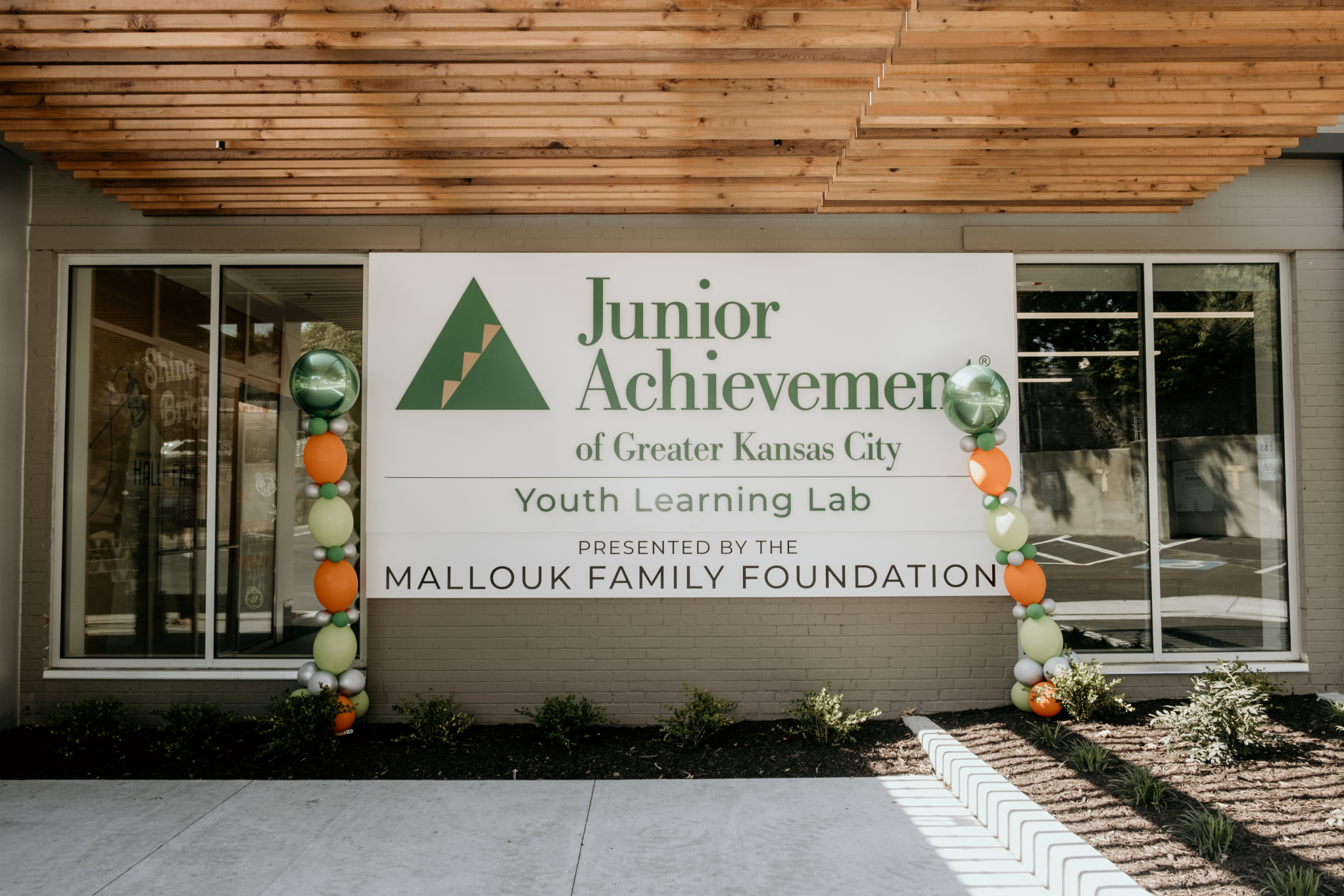
Financial Literacy and Career Readiness Come to Life in Junior Achievement of Greater Kansas City’s New Facility
Junior Achievement of Greater Kansas City · Youth services, Community development
Read more about IFF’s work with Junior Achievement of Greater Kansas City (JAKC). Amidst the uncertainty and disruption of the pandemic, JAKC opened a new facility that has greatly enhanced the organization’s ability to bring financial decision making, an entrepreneurial mindset, and career readiness to life for children through experiential learning.
Read more about Financial Literacy and Career Readiness Come to Life in Junior Achievement of Greater Kansas City’s New FacilityRelocating a nonprofit to a new facility is daunting. Moving to a new headquarters that allows an organization to radically expand its services multiplies that challenge. But how can a nonprofit do all that in the middle of a once-in-a-century pandemic?
If you ask Megan Sturges, CEO and president of Junior Achievement of Greater Kansas City (JAKC), how she did it, she might tell you, “You need an owner’s representative.” Sturges’ plan to move JAKC into a new home in 2019 led her to LaMar Miller, Managing Director of Real Estate Solutions for IFF’s Southern Region. Together, they overcame unexpected and novel challenges when this project ran headlong into the COVID-19 pandemic in 2020.
Now, nearly five years after completing renovations to a 21,819-square-foot facility and relocating JAKC to the new space, Sturges and Miller sat down with IFF’s Carson Kahoe to reflect on the project, discuss the challenges they faced, and uplift the lessons they learned. Their conversation became the first edition of Community InSites, a limited audio series where nonprofit leaders discuss projects they’ve undertaken to upgrade their organization’s facilities and expand their ability to serve their communities.
Listen to the story here:
Music: Relaxing Lofi – Pentekaideca, produced by Sascha Ende
Link: https://ende.app/en/song/13281-relaxing-lofi-pentekaideca
Watch the video of the conversation here:
You can also read a transcript of the conversation below. This transcript has been revised slightly to improve clarity.
Introduction
Carson Kahoe:
Hello, and welcome to Community InSites, a limited audio series from IFF where we hear from nonprofit leaders about projects they’ve undertaken to upgrade their organization’s facilities and expand their ability to serve their communities. My name is Carson Kahoe, and I work at IFF, a mission-driven lender, developer and real estate consultant that works across the Midwest to help strengthen nonprofits and the communities they serve.
Today we will hear from Megan Sturges, CEO and President of Junior Achievement of Greater Kansas City, or JAKC. And we’ll also be hearing from LaMar Miller, IFF’s managing director of real estate solutions for the Southern Region. Megan will be sharing about her experience relocating JAKC into a new facility to improve the organization’s ability to advance its mission — and doing all of that amid the disruption and uncertainty the COVID-19 pandemic. Throughout this complicated facility project, LaMar led IFF’S real estate consulting support, and he’ll be sharing more information about that.
Thank you Megan and LaMar for joining us.
LaMar Miller:
Absolutely
Megan Sturges:
Thanks. Glad to be here.
Carson Kahoe:
I’d like to get started with just a bit of background information about JAKC. Junior Achievement of Greater Kansas City was founded in 1955 as part of the Junior Achievement National Network. JAKC’S mission is to inspire and prepare young people to succeed in a global economy. Megan, tell us a bit more about JAKC and how you go about doing that work with young people.
Megan Sturges:
Yeah, happy to. I’m always excited to talk about JAKC’s mission, so thanks for the opportunity. We are drawing on a century of success as part of the National Junior Achievement Network, and really our goal is to catalyze cross sector collaboration and deliver innovative solutions that improve educational and economic outcomes. We use a career-connected learning model that is equipping students with the skillsets, mindsets, and behaviors that are needed to succeed not just in the classroom but also in career and life. We have two signature experiences that help us make that come to life. Those include JA BizTown, presented by Community America Credit Union, and then a new 3DE high school immersive model that provides authentic experiences that empower students to see themselves as leaders, entrepreneurs, and ultimately contributors to the community.
Carson Kahoe:
The work that you do is obviously very closely connected to the facility that you work in. So before you moved into your new facility, JAKC operated out of a 3000 square foot office space and hosted all of its programming in classrooms around the Kansas City metro area. I’m curious to know: What was it like to operate your programming in that way, and what ultimately motivated JAKC to relocate to a new facility?
Megan Sturges:
Yeah, I mean, perspective is interesting when you only know one model. Working out of a traditional business office, I didn’t know what could have been at the time. You know, with what I knew and understood is that I felt like we were doing a great job addressing some of the symptoms that school districts were coming to us to say, “We need to help our kids understand how to think about careers and how do we help instill stronger financial literacy skills.” And so that was really the only capabilities that we had at that point in time. A capital project was never on our long-term strategic vision board. However, we started getting phone calls from teachers and school district administrators when there were some shifts in the ecosystem. They called us and they literally said, and I quote, well what can Junior Achievement do? And that powerful question really ensued a very big conversation around, “Well what can we actually do to step up and fill this void,” but also, how can we show up differently and better to really move from symptomatic changes to really addressing some of the root issues.
Carson Kahoe:
So this ecosystem change that you’re talking about, this is what would lead to the BizTown project?
Megan Sturges:
Yeah, JA BizTown has been a product in the national portfolio for almost 25 years. Once that opportunity presented itself, it was like, “Wow, this is an easy pull down for us.” But then we started digging in; “Well we can’t run JA BizTown if we don’t have a facility to make it happen.” And so that’s where all of the things started to happen and really the vision of, “Wow we could create a youth learning lab, and it could be so impactful in this community.”
Carson Kahoe:
Describe really quickly what JA BizTown is.
Megan Sturges:
JA BizTown supports fourth to sixth graders and their ability to really understand and put real world learning into action. So JA BizTown is a simulated economy where students arrive for an experiential day where they embrace the role of employee, consumer and engaged citizen and ultimately they get to experience what a day in the life of an adult would look and feel like and take away so many lessons. Some are fun, some are hard to learn, but most importantly, they’re really establishing some core career competencies that will fuel them and support future economic mobility as they continue to grow and learn and become adults.
Carson Kahoe:
So you recognized this ecosystem change, this need for bringing the JA BizTown into Junior Achievement Greater Kansas City. Once you guys made the decision to make this move for your facility, what were the major milestones from when you first got things started in 2018 through to your facility’s ribbon cutting in 2021?
Megan Sturges:
I mean, I remember the day I walked into a board meeting and said, “I have a $9 million idea.” And they kind of looked at me like, “Get out. Are you crazy?” I mean we were a million dollar operating budget at that point in time. I convinced enough of the board members to say, “Let’s do a feasibility study; let’s really understand what the community is gonna say.” So we initiated that in 2018. We identified who potential some lead investors were going to be during that process and really what the community felt comfortable with. And so in 2019 we officially launched the campaign and started the very tedious process to find a space — that was the most time consuming part, because we had very specific requirements of our facility. We had very specific requirements about location. We needed every school district to be able to easily get there, you know, not abandon certain communities that we’d been part of forever.
Fast forward to 2019, we finally found a space, started some lease negotiations — and then I got really overwhelmed. Lease was almost done and I said, “I don’t know what to do next.” They asked, “Well who’s gonna be your general contractor?” And I said, “I don’t know.” I walked into the board meeting, and I said, “I’m kind of waving the white flag right now. Like I know this was my idea, and I know we’ve made good progress, but I don’t really know what to do yet.” And so after some conversations and talking to other colleagues and peers, they were like, “You really probably need an owner’s rep. You need someone that’s advocating for you that has Junior Achievement’s best interest and quite frankly is an expert in this type of project.” Because this was my very first capital project. I was a fish out of water.
And so finally, you know, we’re able to secure the commitment and the support from the board to say, “Okay, let’s hire an owner’s rep.” And obviously IFF and LaMar was the easy choice. I didn’t know what an owner’s rep was. Full disclosure, I didn’t know what IFF really did. I just knew that I had a trusted person, whoever that person was at the time, say, “Oh you should probably go talk to this organization. It sounds like they can help.” That’s where LaMar really helped me understand like what does an owner’s rep do? What was his education and his background and experience? particularly the niche that they specialize in nonprofit orgs because obviously, we just have different conditions and different resources. And we just always have a lot less probably than any other for-profit entity that it’s going through some kind of leasehold improvement.
Why use an owner’s representative?
Carson Kahoe:
So Lamar tell us what is an owner’s representative? What do you do, and particularly in the context of working with nonprofits, what does that work look like?
LaMar Miller:
I would say we give nonprofits capacity.
Carson Kahoe:
And this is being an owner’s representative specifically in the context of a facility project?
LaMar Miller:
Yeah. So taking on real estate development project — whether it’s a renovation to a current facility, looking at acquiring a new site, doing a site search, whether you actually want to think about consolidating if you have multiple sites, we’ll help you with a strategic facilities plan — really in that context. Build a relationship with your client, try to get in their heads — figure out what’s important to them, what’s not, what they don’t want to be bothered with, what they need to be brought in for — so you can go out there and be their extra arm, advocating on their behalf, and not bog them down with meetings and picking colors. And also being a translator: all the lingo between architects and contractors, lease agreements. And really just mitigating risk. You know, you do have to spend money on us, but we save you—
Megan Sturges:
It’s a significant ROI. Very significant.
“In the nonprofit world, leadership is wearing so many hats, and they’re doing so much. They’re fundraising, they’re managing stakeholders, they’re managing the board, they’re trying to drive their mission and drive their strategic plan. To expect them to put on their real estate cap and go out there and kill it, it’s not fair. Let us come and do that and help you with that so you can focus on the reason why you’re here in the first place.”
LaMar Miller:
With a lot of nonprofit organizations, a real estate development project is probably the first and maybe even only time they’ll ever be doing it while they’re with that organization. And so, it’s a whole different part of your brain in decisions that you have to make.
Megan Sturges:
The other thing nonprofit leaders will absolutely relate that are listening to this is that this is not the only project that we’re working on. We’re running an entire business at the same time. We’re keeping our team accountable and moving forward, because you’re literally running down two super highways when you do a project like this. You still have to do business as usual. But then also this project that’s taking up all of your head space — and there’s just so much risk that’s riding on it — but it’s not the only thing that we have to think about and make decisions on. So that’s where I knew I was like at my breaking point, that I literally have no more room in my head. And so obviously an owner’s rep was a really good decision
LaMar Miller:
In the nonprofit world, leadership is wearing so many hats, and they’re doing so much. They’re fundraising, they’re managing stakeholders, they’re managing the board, they’re trying to drive their mission and drive their strategic plan. To expect them to put on their real estate cap and go out there and kill it, it’s not fair. Let us come and do that and help you with that so you can focus on the reason why you’re here in the first place.
Pandemic work and other challenges
Carson Kahoe:
I’d love to dive more into what it was like to be doing this work in the pandemic. That was such an unprecedented time. February, March, 2020 hit and the world stopped. What was that like? Megan, you as this nonprofit leader trying to finish this project through this pandemic and you, LaMar, as an owner’s representative doing this work and now suddenly being in a completely different world.
LaMar Miller:
I’m trying to picture like a movie — it might have been Boiler Room — where there’s fires on people’s desks, guys are running around sweating, taking off their shirts, everyone’s on the phone trying to figure out what the heck’s going on. It was kind of that feeling for a good hot second.
Megan Sturges:
We thought well maybe this will be a two week thing. We never knew it would be a two year thing. I don’t know that anybody knew what was going to happen. So our initial timeline obviously got extended significantly, just because we were all trying to navigate, how do we stay healthy? How do we stay safe? How do we take care of our team and the community? All the things.
LaMar Miller:
We are still trying to figure out what can we do, what can we not do? Is construction an essential service? Can we push forward?
Megan Sturges:
It was scary, because as a leader of an organization, I feel like my job is to make sure that everyone feels good along the journey and knows where we’re going. And I don’t know that I was doing either of those things very well during the pandemic, because nobody knew, right? And so I think really it was, we just had to start thinking about: What are the potential risks, and how do we have contingency plans for each of them?
And I remember preparing for a board meeting in April of 2020, and I literally had three scenarios from the extreme of: we’re canceling this, we’re gonna break our lease, we’re going to give money back; to we may make the riskiest decision of our organizational history and we’re just going to push forward; and then somewhere in the middle, like, Let’s delay it, let’s see what happens. Because while we were navigating this vision and this long-term plan and the impact that we wanted to make, we’re also a business. And so I was worried about: Are we going to be able to continue to raise the funds? How is the community going to respond to this? What is the community focused on? And who are potential other investors that we could go to? How do I help keep everyone together and happy and on the path forward, without letting this fear that I was literally living with every night that I went to bed, show on my face?
“The respect that my board had for his expertise as a new lens to look at things; the information landed differently when it came from a third party neutral person that had our best interest at heart. That was something I didn’t expect: The confidence that it gave the board and the organization to have an expert in that field, particularly during a very challenging risk period of the project.”
LaMar Miller:
Even during that board meeting, we were still collecting the information. We didn’t have all the data, we don’t have all the facts. If we do that risky thing, here’s all the variables we still don’t have identified. But you know, you had a really supportive board; they asked great questions. She would invite me on calls for portion of them, just to give them those project updates and hear what I was hearing out in the market. And they were very supportive of moving forward
Megan Sturges:
As an owner’s rep, while LaMar and IFF are a neutral party — even though they are working for Junior Achievement — the respect that my board had for his expertise as a new lens to look at things, the information landed differently when it came from a third party neutral person that had our best interest at heart. That was something I didn’t expect: The confidence that it gave the board and the organization to have an expert in that field, particularly during a very challenging risk period of the project.
LaMar Miller:
And just going back to what an owner’s rep does. Yes, we are an agent of the owner. We are there to represent the owner as best we can and advocate tooth and nail for those owners. But we also have relationships with the architects and the general contractors, and credibility with them goes a long way. We’ll all provide each other grace, because it’s a team effort. My job’s not to beat up the architect or the GC.
Carson Kahoe:
Aside from the fact that you guys are running this project in the middle of a once in a century pandemic, what were some of the challenges that you guys ran into?
LaMar Miller:
The most costly challenge, and the one that still just grinds my gears, and it caught all of us off guard, was the tax exemption.
Megan Sturges:
Yeah, I knew you were going to it. I didn’t want to talk about it again — can we just put it to bed? *laughs* The Kansas tax exemption for nonprofits was really where we got tripped up.
LaMar Miller:
I’ve worked in a lot of municipalities, and usually if you’re a nonprofit you already have your tax exemption for projects, and you give that certificate to your contractor, and that’s one less thing you have to think about as far as the large budget number. And we found out that that’s not how it works at the UG. UG stands for unified government.
Megan Sturges:
It’s a Kansas regulation.
LaMar Miller:
So even though they’re a nonprofit organization, if you have a development project, you need to file a project tax exemption. I didn’t know it, the contractor didn’t know it, the architect didn’t know it. We all kind of got caught with our pants down, and quite honestly, we all felt like we failed Megan. It was kind of heartbreaking. And I was like, “Oh man, I don’t know if I’ll ever be able to recover from that.”
Megan Sturges:
We did recover though. We did. We really leaned on the value engineering.
LaMar Miller:
The value engineering process is just a process of saying, “Okay, we have these items in the project. Here are their functions, here are the requirements of durability, here are the parameters they need to meet. Can we find a less expensive version of that that still meets all those criteria?” And so that’s truly what we did. We turned over every rock to make sure we found what we needed to find to kind of negate that mistake.
Megan Sturges:
So we were able to ultimately negate the additional tax expense that we had after LaMar and the GC and the architect led us through the value engineering exercise. So I’d say it’s a happy ending at the end of that. But it was a really tough lesson that we all had to learn.
Getting across the finish line
Carson Kahoe:
You talked about some of these challenges that you guys faced, talked about this huge, unprecedented challenge of working in the middle of the pandemic. Was there a moment where you felt like you crossed off the final thing on the list, you fully made it? Or did it really take up until the minute you cut the ribbon?
LaMar Miller:
I knew this thing had legs when we had the idea for how we were going out to bid to try to find a general contractor during the pandemic. And what was unique about that is we were trying to be safe, and so there was a sanitation station set up with hand sanitizers, masks, gloves, you name it. And — was it you that went through and did a video recording of the entire space that folks could refer to if they weren’t comfortable going to the site?
Megan Sturges:
Yeah.
LaMar Miller:
And honestly, I think the contractors were willing; they were on board. They were like, “Oh man, this is a great idea. This is innovative.” And so we did get a pretty good response of contractors willing to bid a project in this fashion.
Megan Sturges:
So when we picked the GC, that’s when you knew it was all green light go from there? I mean we were kind of contractually obligated at that point. *laughter*
I was really worried about fundraising. I needed visually to see walls going up. I needed to get further into the actual leasehold improvement process for it to really be like, “Okay, this is really happening.” So it was once we actually started seeing walls, particularly in JA BizTown, the simulated city, where I thought, “Okay, this is how this is going to come to life.” I think that really resonated for me. And then when we finally hit public phase, where we were actually putting out press releases: “We’re doing this project, we need your help, community, to get to the finish line.” I mean, there’s nothing like publicly putting something out there to say, “Well now we have to get it done.” Those were the two milestones I think for me.
LaMar Miller:
I want a do-over now! *laughter*
So securing the GC was part one; part two would be closing on the capital stack, closing on the finances, because it always comes down to the wire when you’re doing a New Markets Tax Credit project. Fees are up in the air, then they lock it in the last week. But up until that moment, things are moving, things are getting adjusted. And then as soon as you lock it in and you get that email that we’re closed—
Read more
Curious to learn more about New Markets Tax Credits? Read more in our explainer.
Megan Sturges:
It was weeks and weeks and weeks of a lot of planning and budgeting and understanding compliance and writing legal-ese. It was so worth it; we couldn’t have done this project without capital that was infused from it. But also, I needed an expert who had done it before. One of my pieces of advice to any leader that’s considering a project like ours is you need to have a really strong finance and operations person on your staff, on your team. Maybe it’s a contractor, maybe it’s a full-time. Shout out to Amy Dauer, she’s vice president of operations at Junior Achievement of Greater Kansas City. Amy worked really closely with LaMar on a lot of the backside of the project, conversations that I never should have been involved in. Having a really strong team member that can work with your owner’s rep and get along really well is critical to the project’s success as well.
Carson Kahoe:
I’d love to get a bit more of your reflections from the project. So June 2021 rolls up, you get all the last permits, the wiring and electrical is all in, you cut the ribbon, you guys are moved in, and it’s done now. It’s been a few years. I’d love to get a sense from you, Megan, what impact has this facility had on JAKC’s programming and the way that you guys are able to engage with the Kansas City area’s young people?
Megan Sturges:
As leaders, we very rarely take time to reflect and celebrate everything that has been accomplished. There are three things that I think really have made a significant impact following the completion and opening of the youth learning lab.
Obviously, it allowed us to launch brand new innovative programming; JA BizTown would not have been possible without a physical space to bring kids to, to help them really lean in and envision what a future could look like. Our ultimate goal is to support economic mobility, and we have this unique opportunity at this intersection of education and career to bring those things together. And the youth learning lab literally is a symbolic place where that is happening every day for kids in our community. The youth-centric impact has been magnified significantly because of that.
Second, Junior Achievement’s a great organization, but I like to say that we’re still a best kept secret in Kansas City. But, man, you open a 22,000-square-foot facility and put your name and your logo on everything, and you bring 3000 volunteers in annually? Guess what? Our brand and our awareness and the love for our mission have drastically increased over time. And that’s very organic. We have a very tiny marketing budget, so we really can attest to the fact that that’s because of the facility. And not to be bragging on it, but our facility is really incredible. It’s state of the art, it’s—
LaMar Miller:
Oh, oh I’m going to brag. I’m proud to be a part of this thing. *laughter*
Megan Sturges:
So that has really helped.
And finally, I think the other thing that I never expected but has been so powerful for us is just the ability to recruit and retain really good talent. When you can say you have a state-of-the-art facility, you get to take 12 steps back to the back of the facility, you get to see the life of a fifth grader potentially being changed? That’s a really powerful recruitment tool. Oh, and guess what? You get a standing desk, and you get dual monitors — because in the nonprofit sector we usually are getting the leftovers or the hand-me-downs from a corporation that upgraded their equipment three years ago. And we’re grateful for that donation — but, man, to be able to ask your team, “If you could design your perfect workstation, what do you want?” And they literally wanted three things: They wanted a standup desk, they wanted dual monitors, and they wanted to have like a lot of natural light. Well, check, check, check. We were able to do all of it. So the ability for us to recruit and retain and attract that talent has allowed us to amplify and magnify our impact even further, because you have the right people on the right team at the right time.
“Junior Achievement’s a great organization, but I like to say that we’re still a best kept secret in Kansas City. But, man, you open a 22,000-square-foot facility and put your name and your logo on everything, and you bring 3000 volunteers in annually? Guess what? Our brand and our awareness and the love for our mission have drastically increased over time. And that’s very organic. We have a very tiny marketing budget, so we really can attest to the fact that that’s because of the facility.”
LaMar Miller:
I just want to double click on that. I preach this all the time: Quality facilities matter. There’s a lot of sectors out there — I’m thinking of early childcare — where you’re really maxed out on what you can pay talent in that sector. And if you can provide staff a quality facility, they’re going to choose to stay there rather than go somewhere else where they’re going to make just as much money, but the facility’s not as nice: It has boiler issues, maybe stained ceiling tiles. If you have the ability to increase the quality of your facility, it does help; it has ripple effects. One of those is staff retention, and I think everyone listening will know that constant turnover in staff is not fun. It drains the organization and your resources.
Megan Sturges:
It’s costly.
Takeaways and final thoughts
Carson Kahoe:
Really quickly before we wrap up, Megan, what were three things that you wished you had known when you started this project?
LaMar Miller:
Do not bring up tax exemption. *laughter*
Carson Kahoe:
Oh I won’t.
Megan Sturges:
We’ve already talked about that; the scar tissue has already been scratched, it’s fine. *laughter* I was thinking about it. This is obviously from my own personal experience, what I came into the project knowing, what my leadership experience had been – and remember this was my very first capital project.
So I think the very first thing that I wish I would have known is just a better understanding of the entire process. Just the pure complexity of the project. Obviously, we had some unique conditions with the pandemic, the unique factors of the facility, having a simulated city — but just understanding the pure complexity of it from beginning to end.
And a better understanding of the roles and responsibilities of each party in the project. Because there were a lot of players at the table understanding, particularly the GC, the contractor, the architect, the owner’s rep, but then all the other vendors and all the other players that are at the table. Just having a clear understanding of what everyone’s responsible for and then who holds who accountable.
And then I think the third thing is we had a plan, we had multiple plans, and all those plans went to you know where. Things just happened, and they changed on a dime. Whether it was a pandemic, whether it was thinking an investor was coming in and they didn’t. I knew that we had a plan, but I probably needed seven other contingency plans before I even started to understand what could happen. Take away the pandemic, right? That was the wild card in all of this. But when you’re doing a capital project like this, even the best plans are going to go sideways because things are going to happen, whether you can control it or not. And so just being prepared to pivot; be agile, take recommendations and advice from the people who you’ve hired and trust to be part of your project. Because they really do have your best interests at heart.
LaMar Miller:
This is from someone who had a great team around her, a lot of supports. Plans change, stuff happens.
Megan Sturges:
They sure do. Stuff happens. But we are here and smiling and happy to talk about it now. So obviously, everyone can survive it.
Carson Kahoe:
Megan, you talked about this a little bit too, but if you had any advice, a big lesson, a takeaway that someone who’s in your position, a nonprofit leader who wants to do this sort of project, what would you tell them?
Megan Sturges:
Yeah, so I came up with three. First thing — and this applies to any kind of project that a nonprofit leader is doing, but particularly when you’re in the thick of a capital project — is just keep the end in mind. It’s going to be hard. You’re going to have to make tough decisions. But just stay focused, and make decisions really rooted in: What are you trying to change? What’s the problem you’re trying to solve? What’s the impact you’re trying to leave? And eventually, you’ll make a decision, and it probably won’t matter at the end of it. So don’t get so caught up in the minutiae of the moment and lose track of what the end goal is. If everybody really believes in the end goal, which I think our project was easy for people to get behind, that really does help.
Ultimately, prepare for the unexpected. We talked about a lot of things that we weren’t expecting that went sideways, that we had to figure out how to solve and navigate in real time. That’s just the reality of this, so you can’t go in thinking, “I have the best plan, I have all the money, I have all the experts.” You’re still dealing with humans in real time in a very complex project. Things are going to go unplanned, and good leaders will figure out how to navigate that and lean on the people when they need to.
And I think the third and final one is — and full disclosure, IFF did not tell me to say this, so this is of my own volition here — that you need an owner’s rep. The GC will have someone that says that they’re advocating on behalf of the project, but they don’t have your best interest in mind. It’s still a business, right? And we worked great with our general contractor, they were lovely, they are still an incredible supporter and champion of our work. But you need to have someone who really you can lean on. And so having an owner’s rep, working with IFF, really was a saving grace that I didn’t know how much I needed until we got all the way to the end of the project, and I thought, “Dang, a lot of this wouldn’t have happened if I would’ve been at the helm and thinking I can do all of this alone.”
LaMar Miller:
Another thing folks need to realize is you have to spend a lot of money before you even get to the point of whether or not you have a viable, feasible project. So having someone with strong financial acumen in your back pocket that you can go to and ask, “Hey, does this thing cash flow, or is trying to make this project happen going to take us under? Are we going to reach a point where we can’t sustain this project if it doesn’t launch at this particular time?” So having all that information is crucial. And like I said, working with Megan was great. She allowed me to be vulnerable too. There were times I didn’t have the answer for things, and I’d say, “But I will; the next time we talk I’ll have it.” You have to have that trust with somebody.
“I love being responsive to whatever’s happening. It isn’t transactional; it is a relationship. And so I want to honor that relationship and have that respect.”
Megan Sturges:
He’s my friend now. We work so well together. And I will tell you — and Lamar said this to me — when your project ends and we cut that ribbon, the relationship didn’t end. I’m not necessarily an active client with IFF right now, but there are things that happen when you run a facility that you also don’t plan for or expect. And so I’ve called him multiple times over the last five years, and he has been there in a heartbeat. He really has been an advocate and a champion for us.
LaMar Miller:
And I love being responsive to whatever’s happening. It isn’t transactional; it is a relationship. And so I want to honor that relationship and have that respect.
Carson Kahoe:
That friendship is very obvious from where I’m sitting right here. It’s been fantastic for me to hear you guys talk about this work. So Laura and Megan, thank you guys both so much for joining me today.
Megan Sturges:
You’re welcome. Fun time. Thanks for the opportunity. It was fun.
LaMar Miller:
Yeah. I mean I have to go see my therapist now, but…
Carson Kahoe:
Hey, don’t we all!
Megan Sturges:
We didn’t bring up too many old wounds!
Closeout
Carson Kahoe:
Well that about wraps up today’s episode. I want to thank again Megan and Lamar for joining me to talk about JAKC’s facility journey. If you’d like to learn more about JAKC or schedule a visit to their beautiful facility, visit jagkc.org, or reach out to the team at info@jagkc.org.
Are you a nonprofit in the Midwest interested in upgrading your facilities? Visit iff.org to learn more about our lending and real estate consulting services, or follow us on Facebook, LinkedIn, X and YouTube at @IFFcdfi. And feel free to reach out to LaMar directly at lmiller@iff.org if you have any questions for him specifically.
Finally, I want to give a huge shout out to Our Spot KC, who is graciously providing the space, equipment, and engineering for today’s recording. Our Spot KC is a hub dedicated to providing essential resources to support, advance, and equip LGBTQ+ individuals in the Kansas City area by offering safe, accepting, and affirming programming services and resources. Our Spot KC works to ensure the sustainability and growth of the city’s LGBTQ+ community. Check them out at ourspotkc.org to learn more. And thank you, Our Spot KC. You guys are great.
Thank you for listening, and we’ll see you next time.